

Calibration chain CHAINCAL-9000
Accurate belt scales mean a reliable metallurgical balance. CHAINCAL-9000 lets you verify belt scales regularly on conveyors from 2 000 t/h — without wagons of test material and with minimal impact on plant operation.
Every percent of error is hundreds of tonnes
Belt scales are the cash register of a concentrator. They are used to account for feed and products, reconcile the metallurgical balance and report to owners and regulators. If the scales are wrong, the whole balance is wrong.
On a 2 000 t/h conveyor, an error of just 1% means 20 t per hour and almost 500 t per day that the plant accounts for incorrectly. That is why scale calibration is not a formality but a production control tool.
Why not calibrate with material every time
Material calibration is the most accurate method, but also the heaviest. At 2 000 t/h a representative test needs 15–50% of the design hourly rate: 300 to 1 000 t of material, that is 5 to 17 rail wagons of 60 t. For regular checks this is too costly and too slow.
So material calibration is done at commissioning and after major changes, while the calibration chain keeps the scale accurate in between.
| Calibration method | Accuracy | When to use |
|---|---|---|
| Material test | Highest | The reference is real material passed over the scale. Accurate, but requires hundreds of tonnes, certified bins and time. For commissioning and after major overhauls. |
| CHAINCAL-9000 calibration chain | High | The best balance of accuracy and practicality. The chain reproduces the material load, belt profile and idler behaviour. For regular checks. |
| Test weights | Medium | Static weights on the weighbridge. Simple, but ignores belt behaviour and tension. |
| Resistor (electronic) | Low | Electronic load simulation. Checks the electronics, but is not suitable for balance calculations. |
What CHAINCAL-9000 delivers
- A load like a real stream. The chain reproduces the distribution and effect of material on the belt rather than simply pressing on a load cell.
- Accounts for conveyor behaviour. Belt tension, sag between idlers and contact interactions affect the error — chain calibration captures all of this in the result.
- No heavy weights or long shutdowns. No need to haul hundreds of tonnes or move static masses. Production loses almost no time.
- A verification document. The chain’s metrological certificate gives a legally valid result for accounting audits.
| Error before: ±2.0 % | ±$6.0 M/yr |
| After calibration: ±0.5 % | ±$1.5 M/yr |
| Calibration effect | $4.5 M/yr |
| Investment in the chain | $200 000 |
How it works
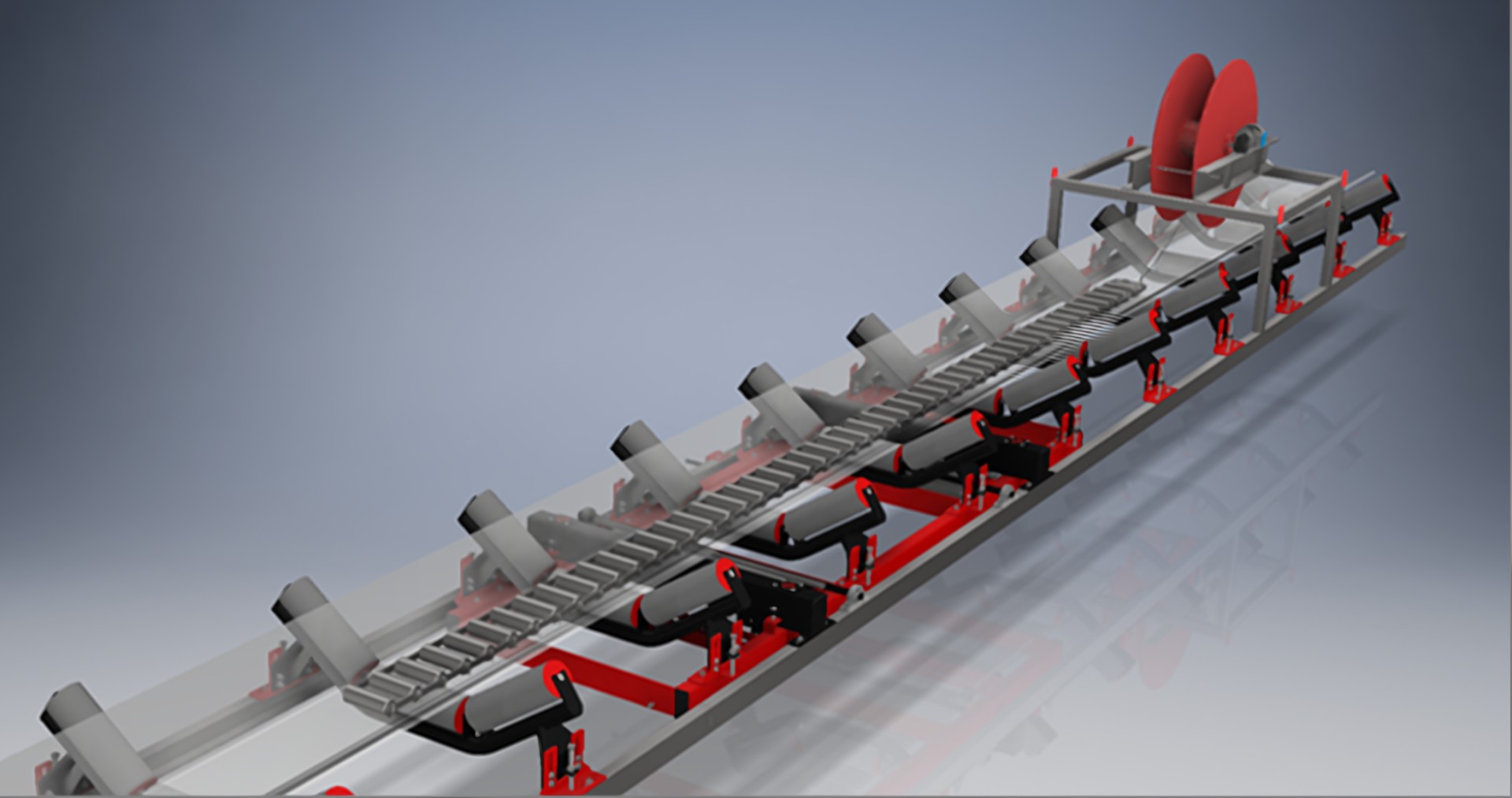
- The chain is stored on a drum above the conveyor and takes up no space. The drum can be motorised with a brake motor and reversing drive.
- For a check, the chain is lowered onto the weighing section — between the idlers before and after the scale.
- A flexible roller chain 5–10 m long with low-friction rollers lies on the belt, and the belt runs underneath it.
- A set of metrologically matched plates sets an exact linear mass. The scale receives a stable, repeatable load.
- The scale reading is compared with the certified chain mass and the integrator is corrected if needed. After the check the chain is wound back onto the drum.
How to organise calibration at the plant
- Material calibration — at commissioning and after significant overhauls.
- Calibration chain — the main procedure for regular checks.
- Metrological records — chain certificates, calibration reports, integrator corrections and verification logs. This matters for statutory reporting.
- The chain length and linear mass are selected for the conveyor: speed, idler spacing, length of the weighing section.
We will size a chain for your conveyor
Send us the conveyor parameters — capacity, belt speed and width, idler spacing — and we will propose a solution and prepare a commercial offer.
Email: sales@bmhsolutions.kz
Phone: +7 702 245 00 32